Maaike de Jong, Maritime officer on ocean-going sailing ships, instructor, and researcher in the fields of governance, sustainability, and cultural heritage
On this website, women from the maritime sector share their stories. This is the story of Maaike de Jong.
What kind of work do you do?
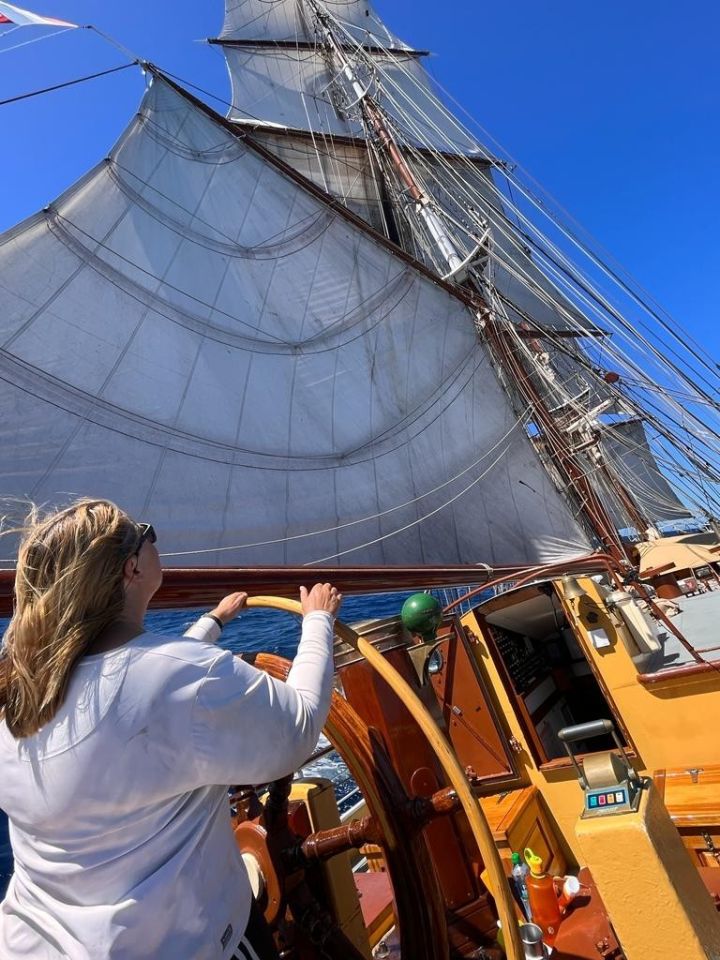
Although I had been sailing with the Sea Scouts since I was a child, I didn’t begin my training at the Enkhuizen Maritime Academy until 2018. I did this while working in higher education. I was eager to learn more about professional sailing, navigation, meteorology, and sailing large traditional sailing ships. There, I earned my certification as a maritime officer for seagoing sailing vessels up to 500 GT. Afterward, I enrolled in the Skipper-Engineer (Limited Operating Area) program because I wanted to gain a deeper understanding of ship engines and the technical aspects of sailing, as well as to gain experience on other types of vessels. For example, I sailed as a volunteer on the Dageraad, a former pilot boat that is now used for recreational fishing. My interests lie primarily in traditional sailing ships, sustainable maritime transport, and the preservation of maritime heritage. In 2021, I sailed aboard the sailing cargo ship Tres Hombres, on which we transported some 19,000 bottles of organic wine from France to Copenhagen. The crew helped with loading and unloading. It was a special experience to see that cargo transport under sail is still possible today. One of my most memorable journeys took place from November 2022 to March 2023, when I spent four months aboard the Morgenster (a historic brig) during a pioneering voyage organized by Fair Ferry, which took us to four continents. Sailing from Rotterdam, we traveled via the Canary Islands and Cape Verde to French Guiana, Suriname, the Caribbean, Bermuda, and back to the Netherlands via the Azores. I also used that time to conduct research on sustainable passenger transport by sea. How does something like that work in practice? What does it mean when you don’t fly to the other side of the world in a few hours, but instead take weeks to get there? What do people learn along the way about themselves, nature, and living together on board? That last point still occupies my thoughts. I’m conducting research on the significance of traditional sailing and how a sailing voyage can contribute to personal development. I’m also involved in the maritime world on an administrative level. I’m a board member of DwarsTuig, the alumni association of the Enkhuizen Maritime Academy, and of the Zeilschipper Foundation, which is dedicated to preserving the traditional profession of sailing skipper (recognized as intangible cultural heritage) and passing on the associated craftsmanship. In addition, I am involved with an organization that promotes sustainable sailing and the transport of cargo and passengers under sail.
Does being a woman play a role in your work?
Sailing has traditionally been a man’s world, but fortunately I’ve also met many remarkable female sailors. On the Morgenster, women of all ages sail along—from deckhands and a young boatswain to future helmswomen. The oldest female trainee was nearly 80! Everyone took their turn on watch, stood at the helm, and helped with the sails. I loved seeing how many different paths had led these women to the sea. Some had made it their career, while others had started later in life, just like me. Of course, the work sometimes requires quite a bit of physical strength. But seamanship is about much more than that. Knowledge, teamwork, insight, responsibility, and knowing when to ask for help are just as important. My advice to other women is, above all, not to let yourself be held back because you think you’re too old, not strong enough, or lack experience. I myself didn’t start my maritime adventure until I was around 50. There’s always something new to learn, and there are plenty of opportunities to gain experience as a volunteer or trainee before you decide to pursue formal training.
What do you like most about your job?
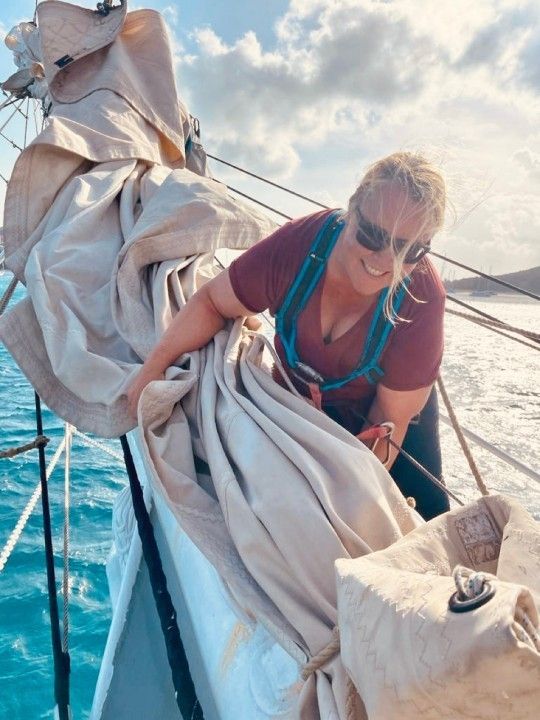
What I perhaps like best is that you never stop learning at sea. During an ocean crossing, you live together for weeks on a relatively small ship. You take turns on watch, steer, navigate, work the sails, and help each other when needed. Meanwhile, the wind, weather, and sea largely determine what your day will be like. At sea, you realize how important it is to be able to rely on one another, and how relative some things become that seem so important on shore. As a researcher, I’m particularly interested in how such experiences affect people in the long term. A voyage can remain a fond memory, but it can also be the start of something new. I know people who once boarded a traditional sailing ship as guests and eventually became helmsmen or captains themselves. I think that’s a wonderful aspect of traditional sailing. It not only keeps historic ships afloat but also passes on knowledge, skills, and a way of life.
During our return voyage across the Atlantic Ocean, from Bermuda to the Azores, we found ourselves in a severe low-pressure system aboard the Morgenster. We had to lower nearly all the sails and continued on with a greatly reduced sail area. I was on the white watch (from noon to 4 p.m.), both during the day and in the middle of the night. There you stand at the helm, surrounded by a vast ocean, with huge waves and strong winds. In those moments, you’re acutely aware of the ship, the crew, and the power of nature. But I also remember other moments, like the conversations during the night watches and the special places we visited. In Horta, in the Azores, I naturally went to the famous Peter’s Café Sport, a gathering place for seafarers. A painting of our ship was created on the quay wall, just as generations of seafarers had done before us. What I’d like to emphasize is that traditional sailing is much more than just nostalgia. These ships also have a future. They can contribute to more sustainable transportation, education, and the preservation of maritime knowledge.
My advice to other women is, above all, not to let yourself be held back because you think you're too old, not strong enough, or don't have enough experience.