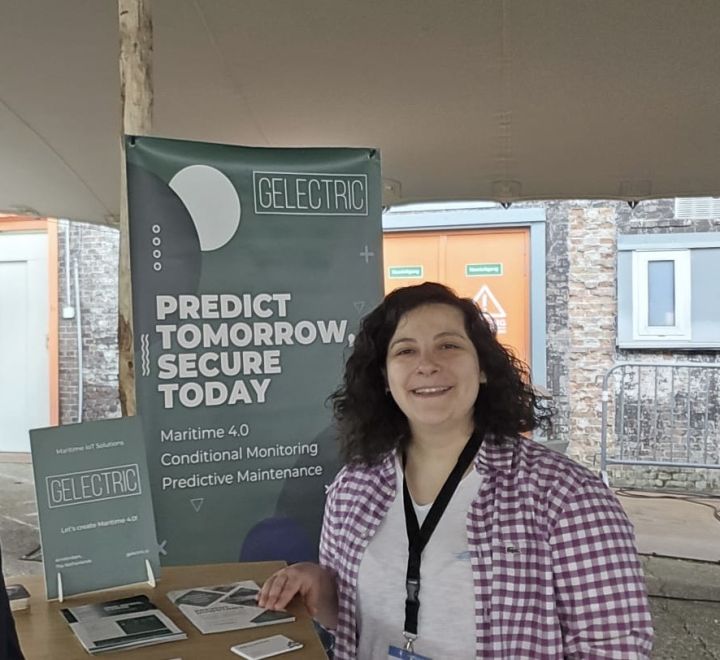
Efil Bengisu Saygi, CEO and Cofounder Gelectric
On this website, women from the maritime sector share their stories. This is the story of Efil Bengisu Saygi.
What kind of work do you do?
As an electrical engineer and the CEO and Cofounder of Gelectric, my work centers on bridging the critical intelligence gap in the maritime industry. I lead a team dedicated to transforming ‘dark data’, the massive volume of unstructured, fragmented, and manual logs currently sitting unused, into structured, actionable building blocks for maritime Al. Our approach allows us to enable data-driven performance optimization and support digital transformation with minimal investment requirements. I chose the engineering profession because I am driven by the challenge of turning technical chaos into structured solutions. Engineering provides the unique toolkit necessary to build systems that solve real-world industrial problems, and in the maritime sector, the opportunity to apply physics-based reasoning to unstructured data is immense. I see this profession as a vital bridge between theoretical innovation and practical, sustainable industrial progress. I believe engineering is fundamentally about creating clarity and reliability in complex environments. We apply this philosophy by taking ‘messy’ maritime data and turning it into verified intelligence that improves vessel performance and fuel analytics. For me, the profession is at its best when it empowers traditional industries to evolve through clean, structured, and accessible technology.
Does being a woman play a role in your work?
In this male-dominated industry, being a woman presents a dual reality: while there is often an initial ‘credibility tax’ that requires me to be doubly prepared, it also provides a unique platform to challenge long-standing norms with a fresh perspective. My tip for other women in maritime is to lead with technical expertise; when you demonstrate the ability to turn ‘data chaos’ into actionable intelligence, your competence becomes the primary focus. By turning visibility into power and building a strong support ecosystem, we can define the ‘new maritime’ as a space that is not only digital but fundamentally inclusive.
What do you like most about your job?
What I like best about my job is the opportunity to be a pioneer in the maritime industry, leading the transition from traditional, manual operations to a digital-first future. Being at the forefront of this shift allows me to redefine how the sector values its information. It is incredibly rewarding to build the ‘Analytical Brain’ that bridges the gap between legacy analogue documentation and modern performance optimization. This pioneering role is fulfilling because it allows us to support the digital transformation of the maritime industry with minimum investment requirements, ensuring that legacy fleets are not left behind. By developing a different approach, we are proving that innovation doesn’t always require heavy hardware, it requires the technical vision to unlock the intelligence already hidden in dark data. For me, the excitement lies in creating these new standards for data-driven performance and sustainability.
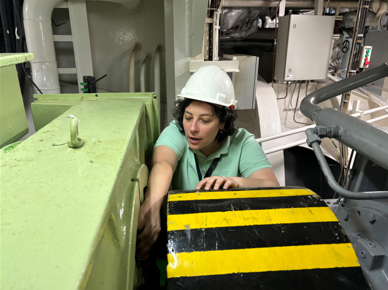
Something remarkable happened during an early visit to a vessel & engine room. I watched a crew member, with decades of experience, meticulously handwriting a noon report, in a physical logbook while surrounded by incredibly complex, multi-million-dollar machinery. It was a striking paradox: the heartbeat of global trade was being recorded with a pen and paper, and that critical data was essentially dying the moment the book was closed. That moment solidified our mission. I realized that to modernize this industry, we didn’t need to force engineers to install more intrusive hardware; we needed to respect their existing workflow while providing an Analytical Brain that could understand it. Seeing the look of relief on a maritime professionals face when they realize our AI can handle that manual & data chaos; for them is what makes being a pioneer in this space so worthwhile.
My tip for other women in maritime is to lead with expertise