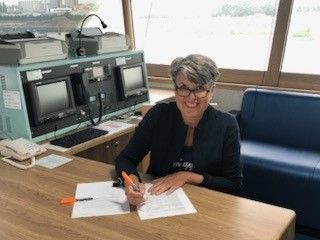
Marga de Mol, e-Coach / external confidential advisor for the maritime sector at Het Beste Uit Jezelf Halen
On this website, women from the maritime sector share their stories. This is the story of Marga de Mol.
What kind of work do you do?
My work takes place in a world that is invisible to many, yet invaluable: the maritime sector. As a coach for seafarers, I support people who work at sea for extended periods to strengthen their mental fitness, leadership skills, and overall well-being—both on board and when they’re back on shore.
The work environment at sea is unique and demanding. Seafarers are often away from home for long periods, work under high pressure, and are part of teams with diverse cultures, ages, and backgrounds. Within that context, I focus my coaching on issues specific to life on board, such as navigating hierarchy, collaborating effectively in multicultural teams, and functioning in an environment where you rely on one another. In leadership programs, I support seafarers in developing the skills to lead with strength and empathy, especially when the pressure is high and decisions must be made quickly.
On a personal level, I help build self-confidence, find a healthy work-life balance, and strengthen mental resilience. Topics such as stress, loneliness, and homesickness are also addressed. Additionally, communication plays a crucial role. By improving communication skills, there is greater understanding and better cooperation on board. This helps prevent incidents and contributes to a safe and healthy work environment. In this way, I work with seafarers to enhance social safety and mental health—something that remains too often overlooked in this sector, yet is essential for preventing absenteeism and keeping crews strong and resilient.
What makes my work special is the combination of my role as an e-coach and external confidential advisor. I coach “below the waterline”: on the issues that aren’t always visible but have a major impact. At the same time, I offer a safe space where seafarers can turn when they experience a socially unsafe situation. As an external and independent confidential advisor, I am an accessible point of contact, free from any conflict of interest. My choice of this profession stems from a deep fascination with shipping and a strong commitment to the person behind the professional. In an industry where a no-nonsense mentality prevails and pushing through is often taken for granted, I see how important it is to make room for personal stories and vulnerability.
Does being a woman play a role in your studies?
Being a woman adds a valuable extra dimension to my work—not as a stereotype, but as a strength that becomes evident in how I work. In the maritime sector, which is quite masculine and hierarchical, my presence as a woman can lower barriers. Seafarers often feel more comfortable talking about personal or emotional topics, which they are less likely to share among themselves. That allows me to get “below the waterline” more easily. While leadership on board is sometimes highly task-oriented and directive, I focus more on relational dynamics, communication, and social safety. I demonstrate that effective leadership is also about listening, connecting, and psychological safety—without compromising decisiveness.
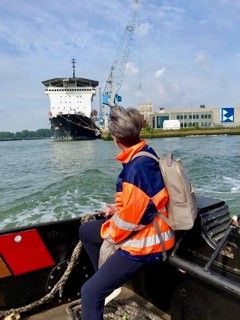
As a woman, I often notice tensions, exclusion, or unsafe situations within a team more quickly. Especially in multicultural crews, where much happens implicitly, this is a major strength. And I represent—perhaps without explicitly intending to—a broader trend within the shipping industry: greater diversity and a focus on well-being. This makes my work not only supportive but also innovative for the sector. For some crew members, especially when it comes to sensitive topics like inappropriate behavior, bullying, or loneliness, it can feel more comfortable to talk to a woman. That increases the likelihood that people will speak up at an early stage. Ultimately, my added value lies not in the fact that I am a woman, but in how I apply my strengths. Being a woman enhances my approach to work—it’s not a label, but a depth of understanding.
What do you like most about your job?
The impact I can make. It’s very rewarding to empower people, especially in an environment where it’s not easy to distance yourself from a difficult situation. At the same time, the work can be intense and challenging. This job demands a lot, but gives even more in return. Every step that contributes to a stronger, safer, and healthier crew makes it all worthwhile.
It was a special moment when I was invited to attend the retirement of a captain whom I had coached years earlier because his behaviour on board was no longer being tolerated. After completing a coaching programme focused on leadership and creating a socially safe working environment, he was allowed to return on board. He shared with the crew that he had worked with a coach and asked them to hold him accountable for his behaviour if he were to fall back into his old patterns. At his farewell, seafarers were present who had sailed with him, including in the years before he was coached. A completely different style of leadership had taken its place. The captain thanked me for the mirror I had held up to him. That is what gets me out of bed every day.
Being a woman adds a valuable extra dimension to my work—not as a stereotype, but as a strength that becomes evident in how I work