Vivian van der Kuil - Maritime lawyer
On this website, women from the maritime sector share their stories. This is the story of maritime lawyer.
What kind of work do you do?
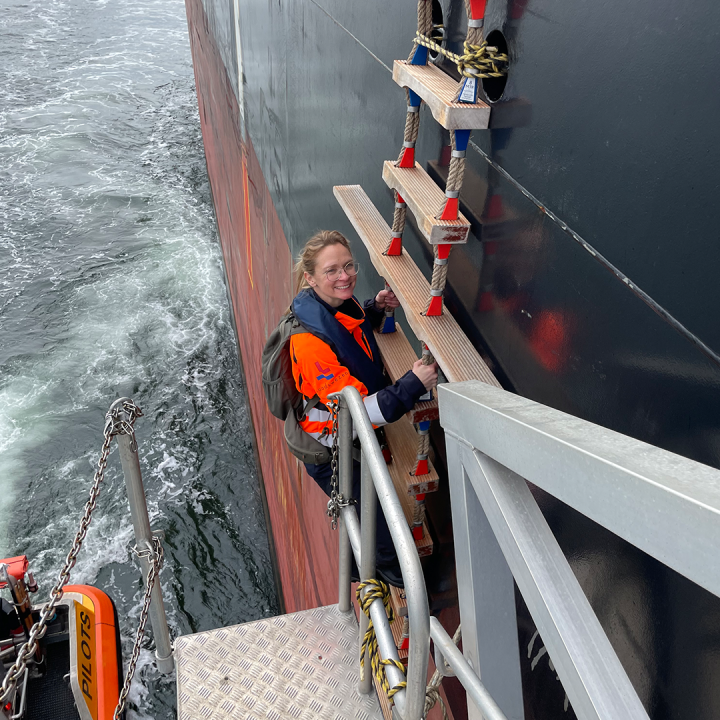
As a maritime lawyer, I handle all kinds of legal matters involving ships or shipping companies. From shipbuilding contracts or charter parties to maritime accidents such as collisions and wreck removal. I particularly enjoy that last type of work: it’s legally complex and at the same time very hands-on.
As a little girl, I didn’t want to be a ballerina—I wanted to join the navy. At fifteen, I attended the open house at the KIM; three years later, I was admitted to the officer training program for the naval service. While majoring in International Security Studies, I was introduced to international law.
I sailed for a while and studied law part-time. When I subsequently began training to become a command center officer, it became clear to me after a few months that it wasn’t for me and that I wanted to continue as a lawyer. I then completed the training program to become a judge and public prosecutor in Arnhem and served as a maritime judge in Rotterdam. Now I am a deputy judge at the Court of Appeal in Arnhem.
Does being a women play a role in your work?
I’ve gone from thinking “it doesn’t matter that I’m a woman” to “it matters a lot.” I had never really considered that joining the Navy was an unusual choice for a woman, until I heard things like “you’re only admitted here because you’re a woman” during officer training. And while women weren’t allowed to serve in the Senate or even on the bar committee of the Midshipmen Corps—the committee that organized the gala (Assaut)—I did manage to join that one.
It wasn’t always easy to get where I was. As a woman, I felt extra pressure not to do anything stupid and to succeed. For example, when I was on watch alone on the bridge for the first time, the boatswain was wearing his life jacket “just for fun.” I could laugh it off, but still.
In 1999, I was rejected from a ship where I really wanted to work because the commander didn’t want women on the bridge. On the ship I was transferred to, it was chaos—charts were missing and not all positions were filled. I didn’t think it was responsible to stand watch independently as an inexperienced watch officer—I was supposed to do that after just three days and during a busy exercise. I refused, was sent away, and even received a medical discharge. The male officer who did take the watch ran the ship aground during that exercise. This experience had a profound impact on me.
There are many women working in the legal profession. Yet the fact remains that when you speak your mind as a woman and are confident in your arguments, things can sometimes get complicated. I’m often told that I’m “bitchy” and not approachable or friendly. On top of that, I don’t have a husband or children. That suits me just fine, but I think people still have an image of women that I don’t fit.
I find that women are often better lawyers than men. Better prepared, sharper, and less hindered by their egos. Yet we’re lagging far behind at the top. That’s why I teach young women to stand up for themselves and to showcase all their accomplishments. Diversity is becoming increasingly close to my heart. In that sense, I do feel like a role model: chart your own course; you can become whatever you want. That feeling I had as a girl—that there are no barriers—everyone should be able to experience that.
What do you like most about your job?
Solving problems with legal wizardry, bringing order to chaos. Helping people. Without it being about me. In the case of the ship that blocked the Suez Canal, we did a lot of work behind the scenes, which allowed the ship to unload its containers in Rotterdam almost without a hitch. I think that’s amazing. I’ve lost my heart to the maritime world, and this work is the best there is. There’s absolutely no reason for a woman not to work here.
It wasn’t always easy to get where I was. As a woman, I felt extra pressure not to do anything stupid and to succeed